Bayesian Data Analysis
Single Parameter Normal
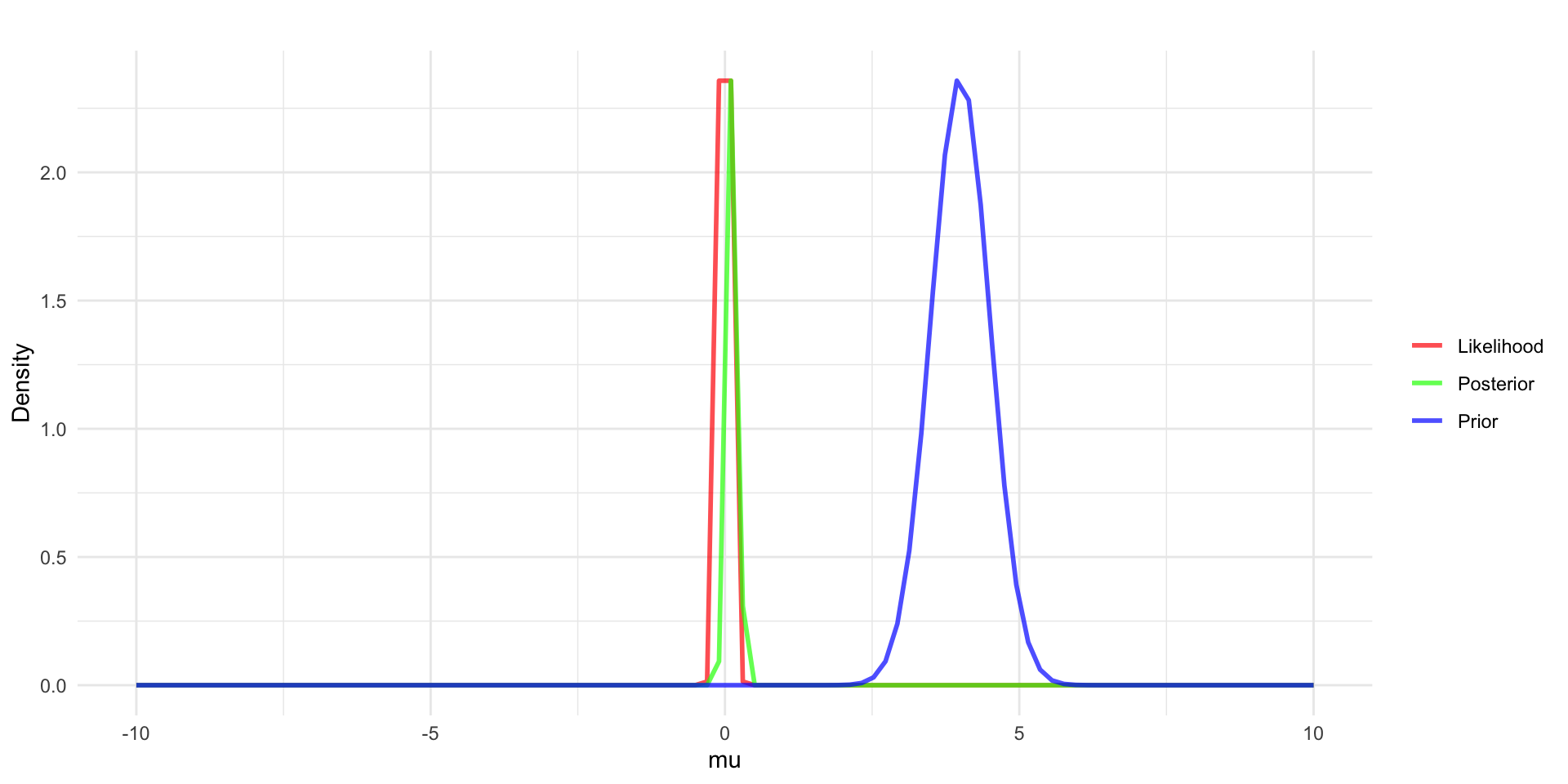
Estimating \(\mu\) from a Normal Distribution
To do Bayesian inference:
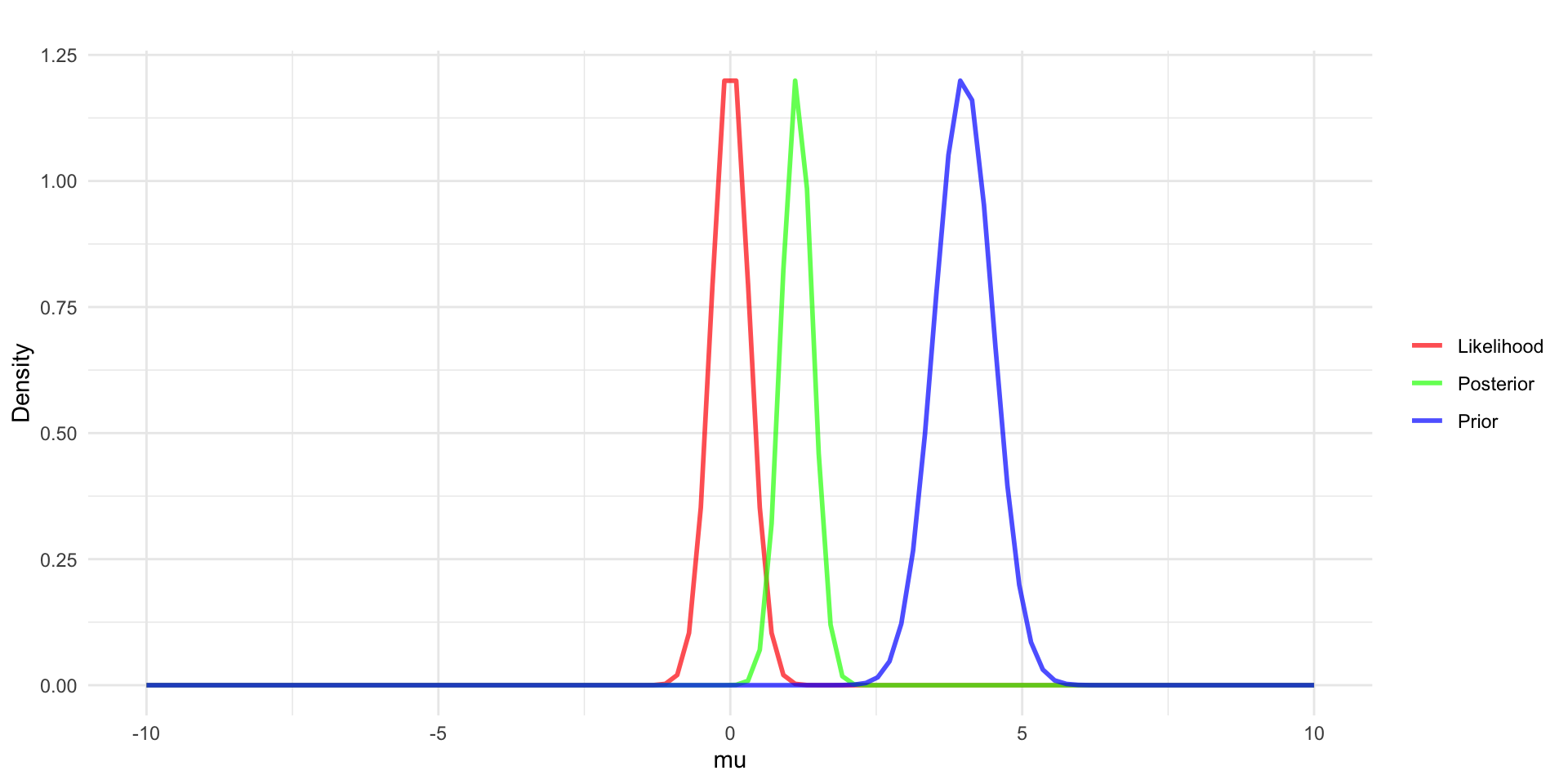
Start off with prior probability distribution to quantify information related to \(\mu\) - example in blue with \(\mu \sim N(4,0.5^2)\)
Collect data, \(y\), assume y has a mean \(\bar{y} = 0\) and that n = 10.
Define the relationship between \(y\) and \(\mu\) through the likelihood function - example in red with \(y_i \sim N(\mu, \sigma = 2)\).
- we’re assuming \(\sigma\) is known here.
Use Bayes’ rule to update the prior into the posterior distribution \(p(\mu|y) \sim N(?,?)\).
Estimating \(\mu\) from a Normal Distribution
To do Bayesian inference:
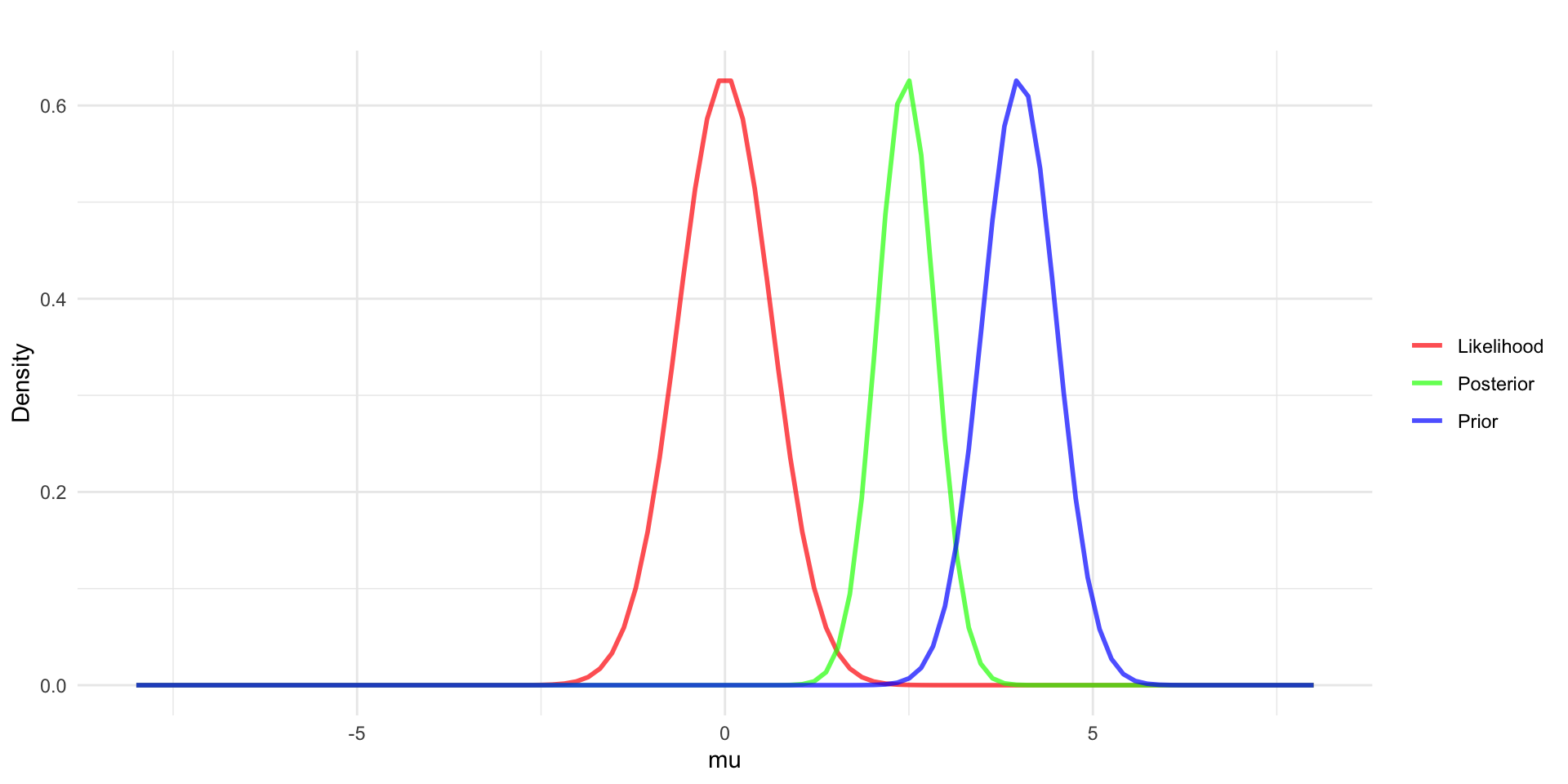
Start off with prior probability distribution to quantify information related to \(\mu\) - example in blue with \(\mu \sim N(4,0.5^2)\)
Collect data, \(y\), assume y has a mean \(\bar{y} = 0\) and that n = 500.
Define the relationship between \(y\) and \(\mu\) through the likelihood function - example in red with \(y_i \sim N(\mu, \sigma = 1)\).
- we’re assuming \(\sigma\) is known here.
Use Bayes’ rule to update the prior into the posterior distribution \(p(\mu|y) \sim N(?,?)\).
Estimating \(\mu\) from a Normal Distribution
To do Bayesian inference:
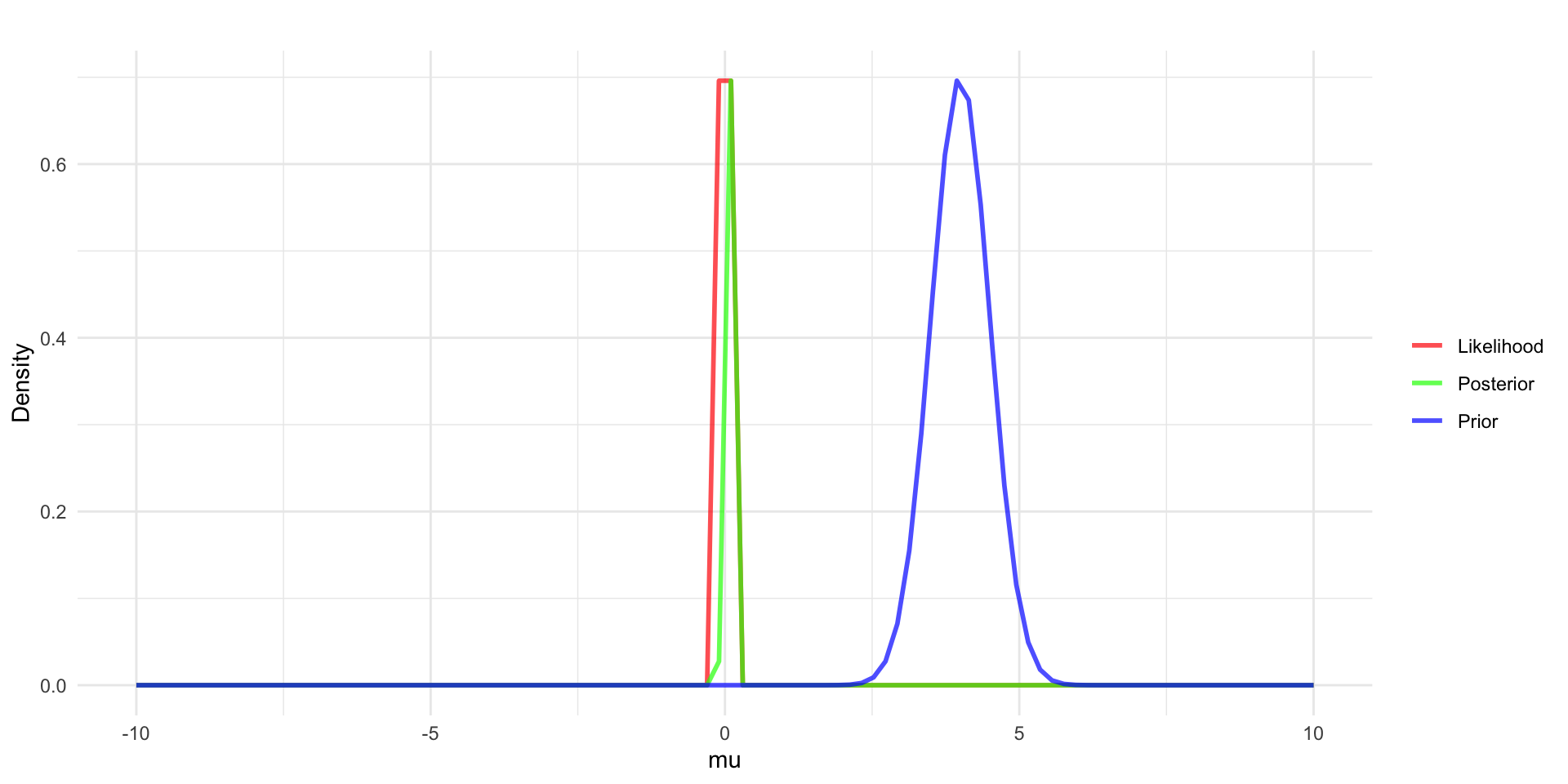
Start off with prior probability distribution to quantify information related to \(\mu\) - example in blue with \(\mu \sim N(4,0.5^2)\)
Collect data, \(y\), assume y has a mean \(\bar{y} = 0\) and that n = 500.
Define the relationship between \(y\) and \(\mu\) through the likelihood function - example in red with \(y_i \sim N(\mu, \sigma = 2)\).
- we’re assuming \(\sigma\) is known here.
Use Bayes’ rule to update the prior into the posterior distribution \(p(\mu|y) \sim N(?,?)\).
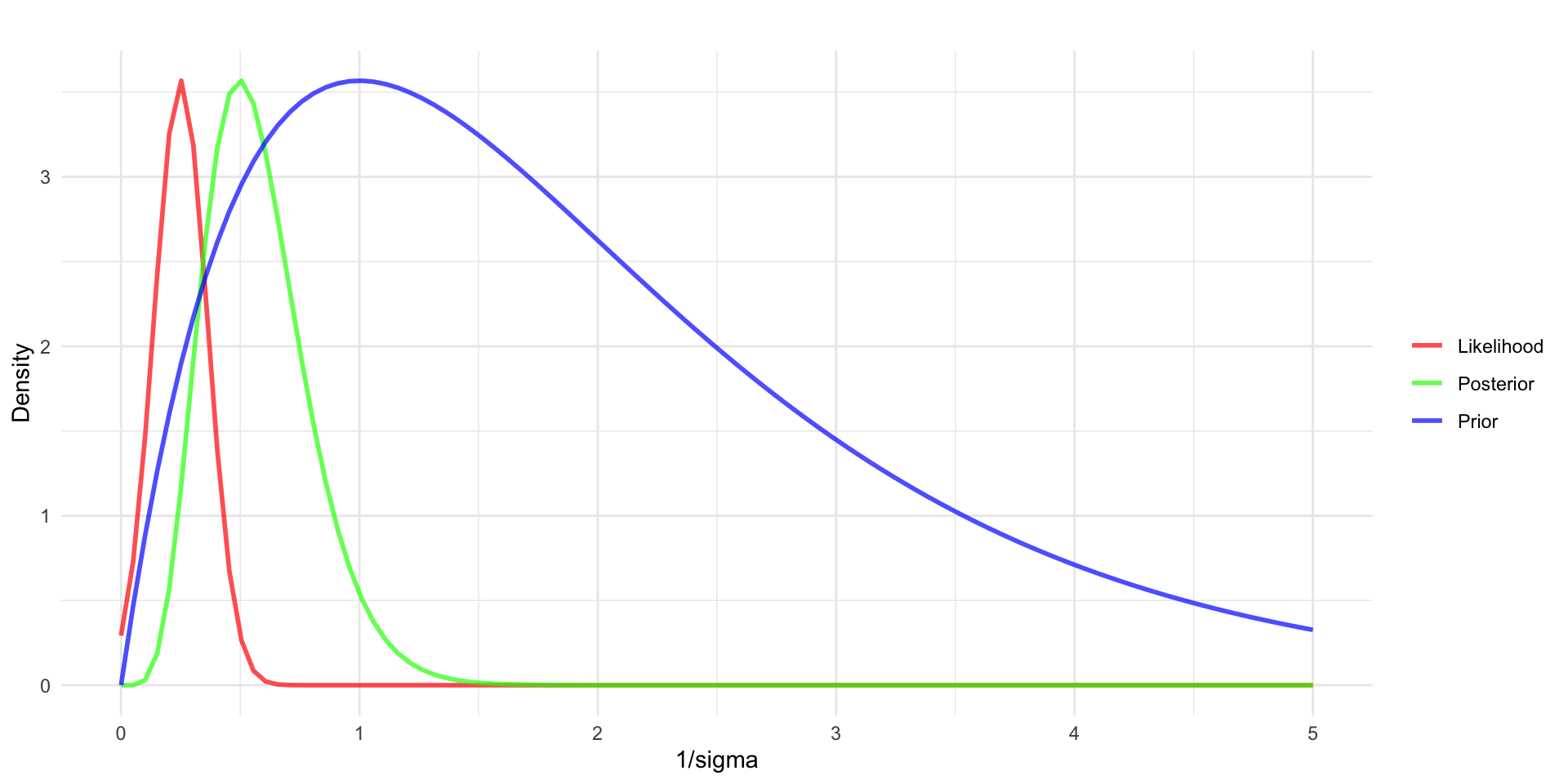
Estimating \(\sigma \text{ } (\tau = 1/\sigma^2)\) from a Normal Distribution
To do Bayesian inference:
Start off with prior probability distribution to quantify information related to \(\tau = 1/\sigma^2\) - example in blue with \(\tau = 1/\sigma^2 \sim gamma(2,1)\)
Collect data, \(y\), assume y has a standard deviation \(s = 2, 1/s^2 = 0.5\) and that n = 10.
Define the relationship between \(y\) and \(\tau\) through the likelihood function - example in red with \(y_i \sim N(\mu = 0, \sigma^2 = 1/\tau)\).
- we’re assuming \(\mu\) is known here.
Use Bayes’ rule to update the prior into the posterior distribution \(p(\tau|y) \sim gamma(?,?)\).
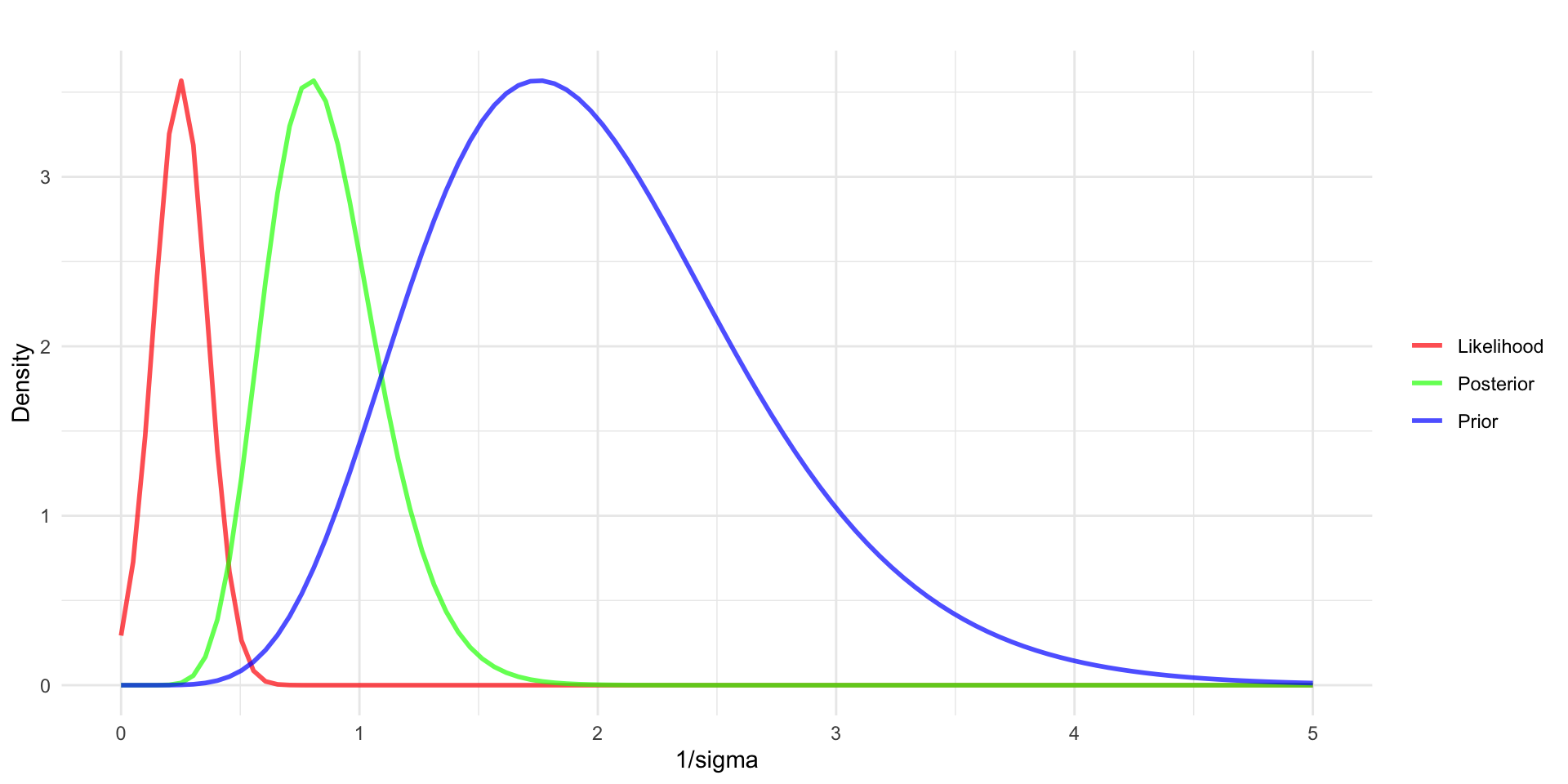
Estimating \(\sigma \text{ } (\tau = 1/\sigma^2)\) from a Normal Distribution
To do Bayesian inference:
Start off with prior probability distribution to quantify information related to \(\tau = 1/\sigma^2\) - example in blue with \(\tau = 1/\sigma^2 \sim gamma(8,4)\)
Collect data, \(y\), assume y has a standard deviation \(s = 2, 1/s^2 = 0.5\) and that n = 10.
Define the relationship between \(y\) and \(\tau\) through the likelihood function - example in red with \(y_i \sim N(\mu = 0, \sigma^2 = 1/\tau)\).
- we’re assuming \(\mu\) is known here.
Use Bayes’ rule to update the prior into the posterior distribution \(p(\tau|y) \sim gamma(?,?)\).
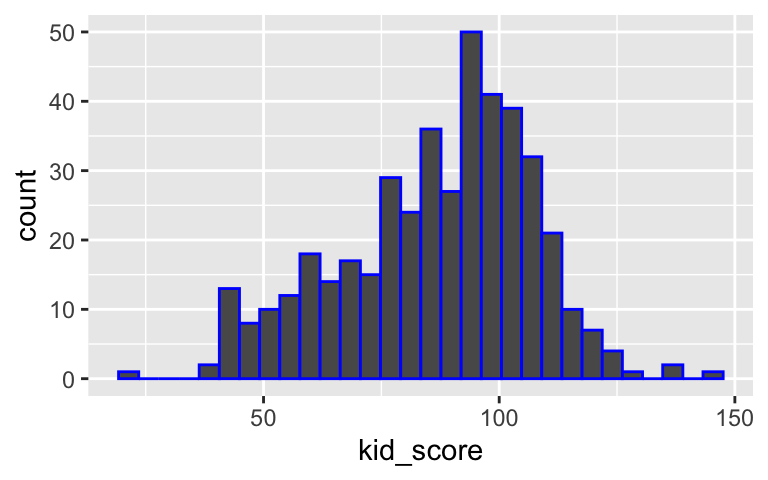
Example: Cognitive Test Scores
Data (y) are available on the cognitive test scores of three- and four-year-old children in the USA. The sample contains \(n=434\) observations.
Normal distribution with known variance
- As it turns out, the posterior is also a normal distribution
\[\mu|y \sim N \bigg(\frac{n\bar{y}/\sigma^2 + \mu_0/\sigma^2_{0}}{n/\sigma^2 + 1/\sigma^2_{0}}, {\frac{1}{n/\sigma^2 + 1/\sigma^2_{0}}}\bigg)\]
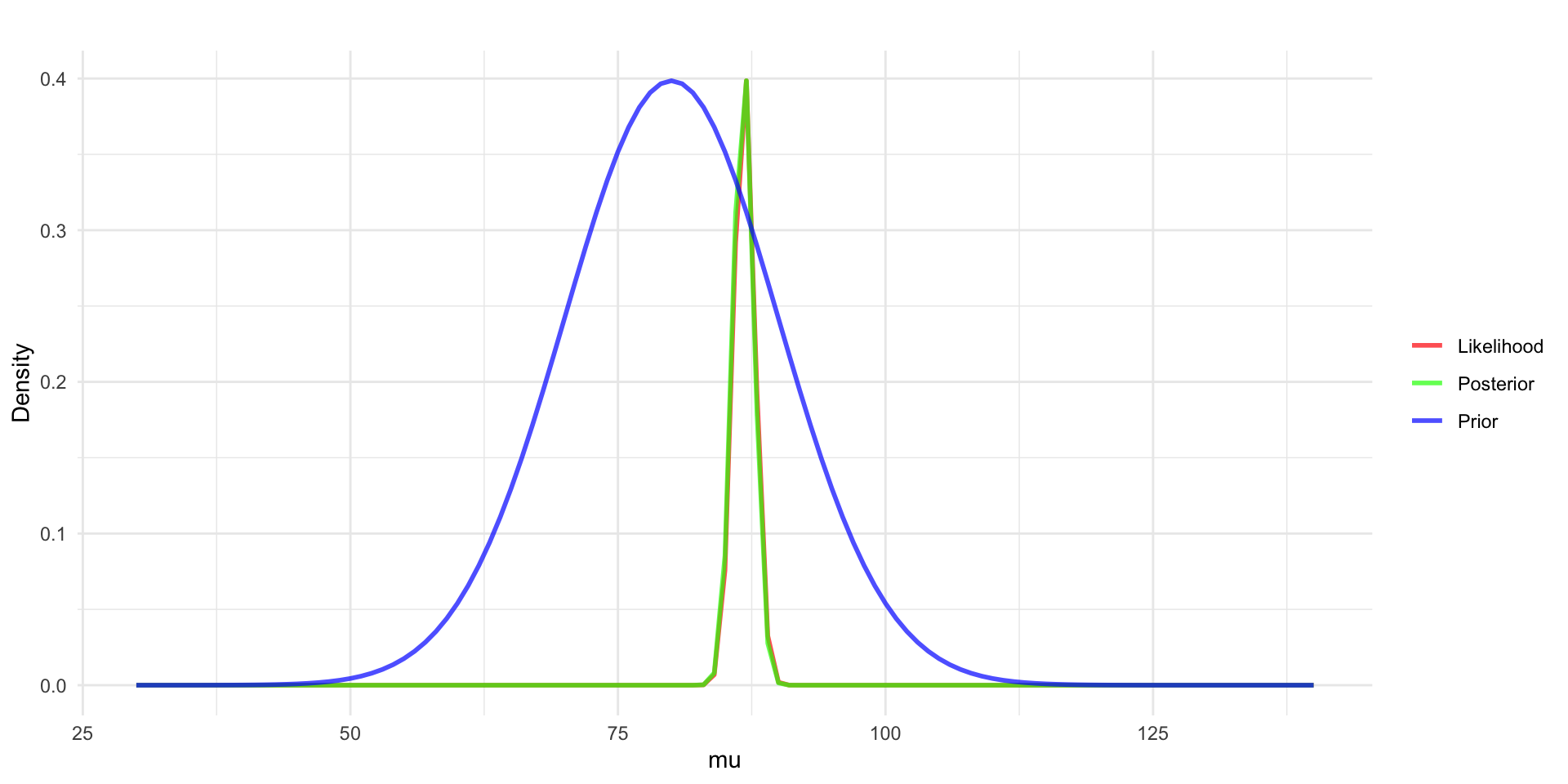
- For the Kid IQ example, assuming \(\mu \sim N(\mu_0 = 80, \sigma_0 = 10)\), then \(\mu|y \sim N(86.7, 0.97)\)
Normal distribution with known mean
- As it turns out, the posterior is also a gamma distribution
\(\tau|y \sim Gamma \bigg(a + n/2, b + 1/2\sum_{i=1}^n (y_i - \mu)^2\bigg)\)
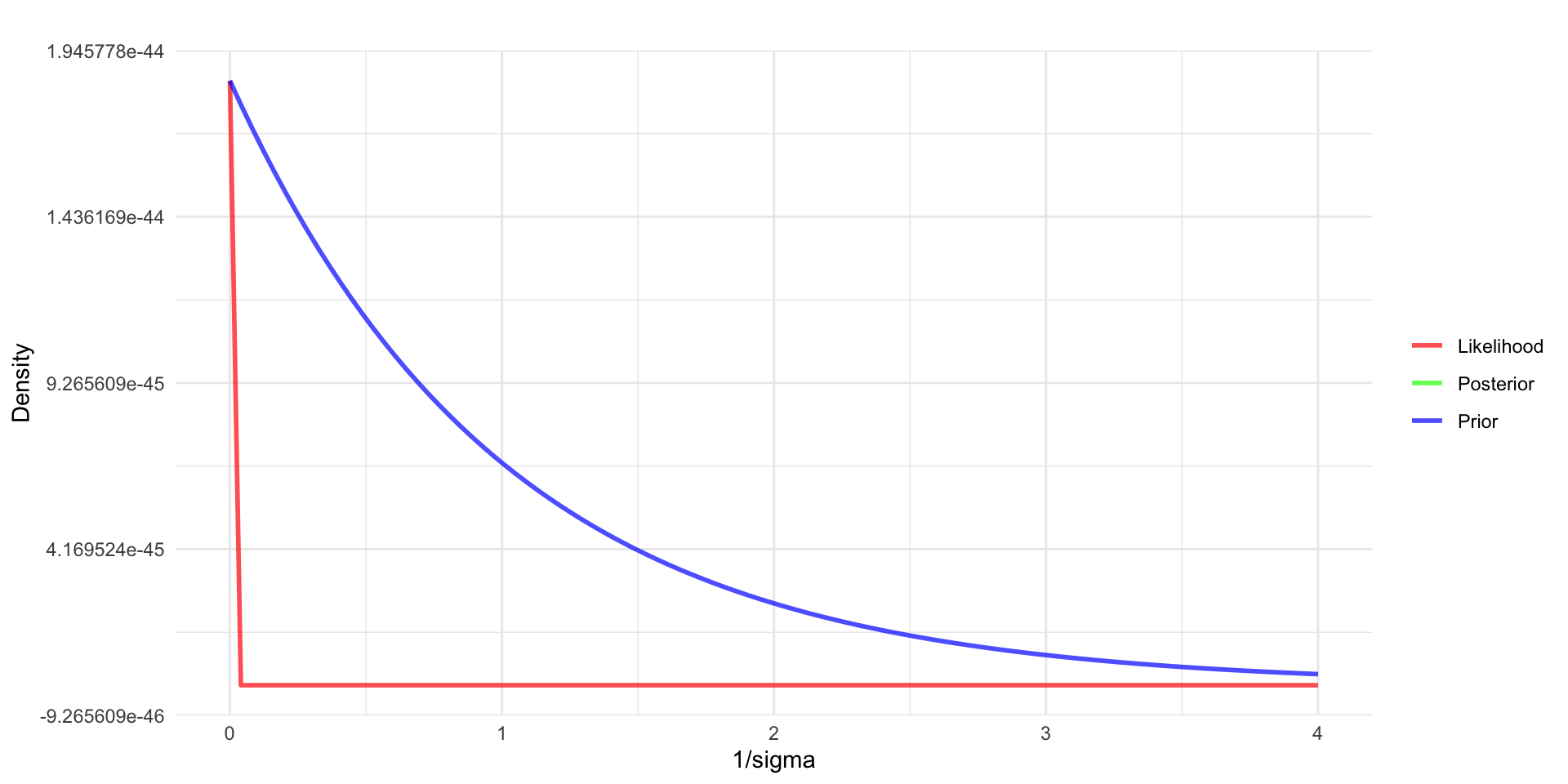
- For the Kid IQ example, assuming \(\tau \sim gamma(a = 1, b = 1)\), then \(\tau|y \sim gamma(218, 90203)\).
Normal distribution with known mean
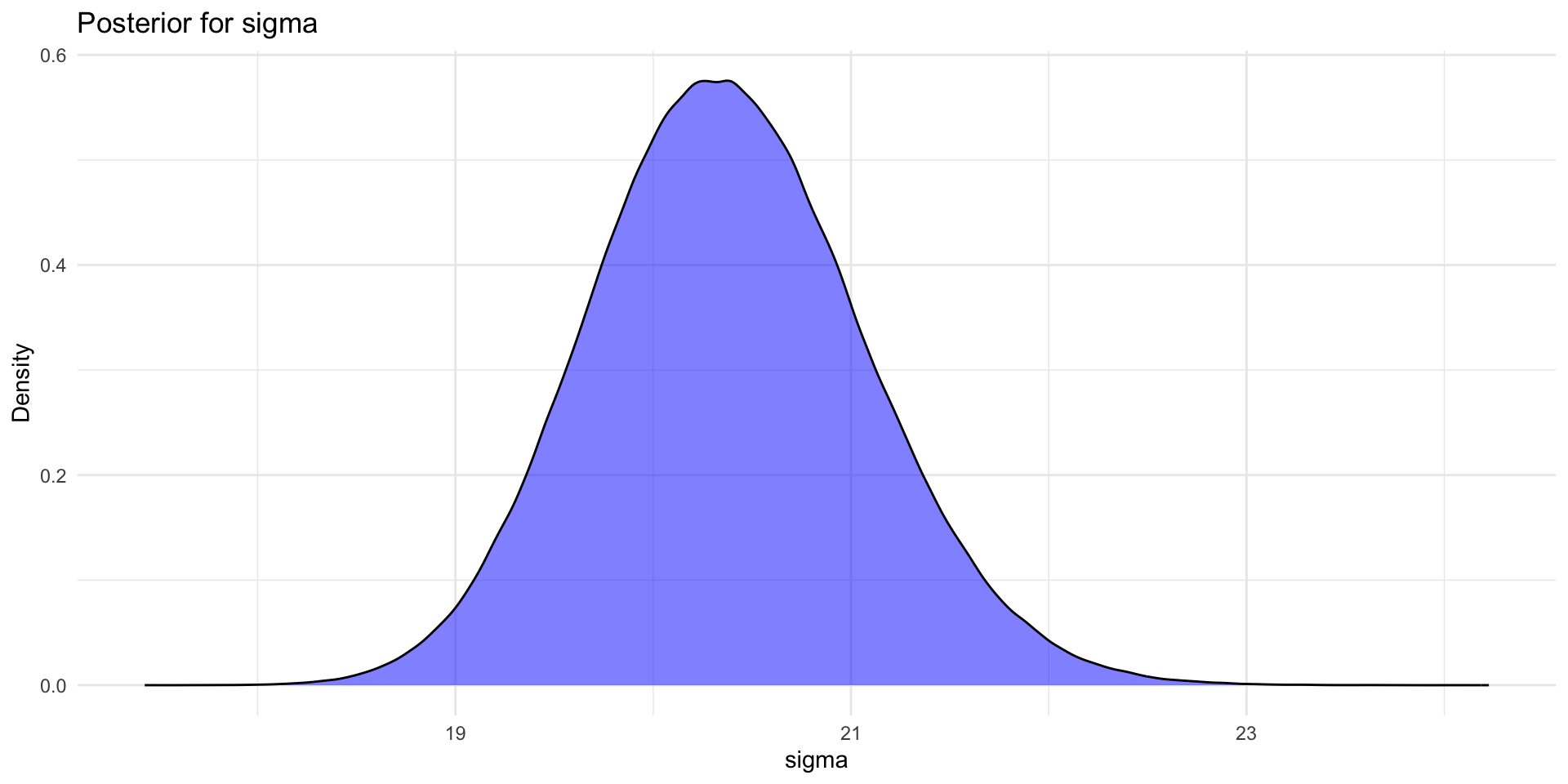
- Converting back from the precision to the standard deviation, the posterior for \(\sigma\) for this example will look more like: